
Blessed Are the Depressed — for They Stand at the Door of Rebirth
Imagine an alien landing on earth and stumbling into the middle of a childbirth. What would they see? A woman screaming in pain, another woman pulling something from her body, blood everywhere…
To the untrained eye, it would look like horror. The alien’s instinct might be to push the midwife away, stop the chaos, rescue the mother from her torment. Only later would they realize: what they were witnessing was not death, but life. Not destruction but a most miraculous creation.
Many of our deepest crises look the same. To the one suffering, and even to those watching from the outside, depression can appear to be an ending. It feels like something has collapsed, and it is hard to imagine that anything good could ever grow from the ruins.
But what if this darkness is not a conclusion at all? What if it is the prelude to a birth?
The Emptying Out
The famous spiritual poet Rumi once compared human life to a guest house. Every day, new visitors arrive — joy, sorrow, shame, loneliness. Some sweep in like honored guests; others come like thieves, violently clearing out the furniture. Yet Rūmī urges us to welcome them all. Even the painful visitors, he says, “may be clearing you out for some new delight.” He concludes with a profound advice:
Be grateful for whoever comes,
because each has been sent
as a guide from beyond.
Here is the gift of depression: it humbles us, it brings us to our knees — and that is the perfect posture for prayer. It holds up a mirror to the hollow places inside us and demands reflection… If we seize it, that pause becomes soul‑searching. These sorrows are not random intruders; they are guides, messengers pointing beyond themselves, whispering: there must be more. The exposure hurts, but it is also preparation — the clearing that makes room for what is next.
A Secret Lesson at Hogwarts: What Can Our Earth Tell Us About God?
A Story for young adults, those young at heart, and all Harry Potter fans.
A gaggle of Hogwarts students, their robes askew and faces alight with curiosity, once gathered around me in the shadowy depths of the library. “Professor”, they whispered, their voices hushed with reverence:
“Tell us of ‘the Secret One’. Our teachers speak only of potions, spells, and charms, but not of the Secret One who first conjured real magic into being.”
I smiled, a twinkle in my eye. “Ah, but my dear students,” I replied, “each subject you study, every potion you brew, and every charm you cast, whispers of the Secret One in its own mystical tongue… Listen closely, and you shall hear the echoes of His divine hand in every incantation.”
“Imagine, if you will,” I began, “a most extraordinary apothecary, its shelves brimming with shimmering glass bottles and bubbling cauldrons. Within each jar, a wondrous elixir, brewed with ingredients gathered from the farthest reaches of the enchanted world, each measure precise and potent…
Surely, such a wondrous place would speak of a master alchemist, a potioneer of unparalleled skill. So much so that, even our legendary Headmaster Albus Dumbledore wishes he could be an apprentice at the feet of such a Lord of Magical Medicine.”
“And so it is with our Earth,” I continued, “a living apothecary, teeming with millions of species of magical creatures and fantastical plants, each a vessel brimming with life-giving remedies. This Earthly apothecary, far grander than a thousand Diagon Alleys, whispers of a Divine Healer, a Genius Scientist who breathed life into every beast and bloom.”
Post 2: Gratitude — The Essence of Islam
In the previous post (“What is the First Sentence of the Quran”), we mentioned that the the first sentence of the Quran was:
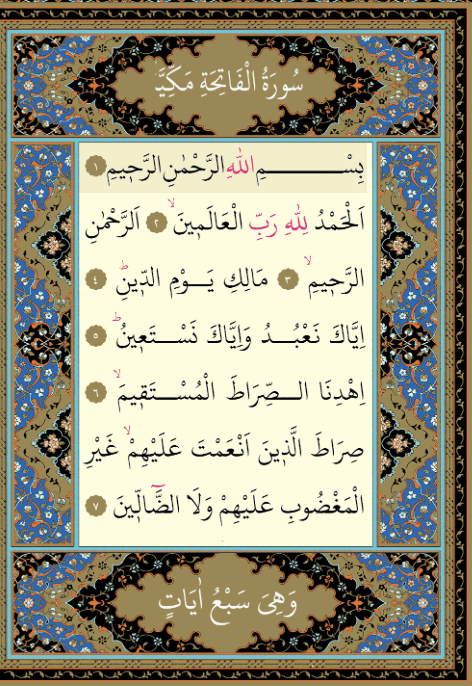
In the Name of Allah, the Most Compassionate, the Most Merciful
This declaration is not only the first sentence of the first Chapter but is also the first sentence of every chapter in the Quran, and Muslims are instructed to begin every good action in life by reciting these words. This is to remind us that as humans we are on this Earth by His Grace and His Love, and therefore we must be mindful that every one of our actions reflects the Compassion and Mercy with which God introduces Himself to us.
The First Page of the Quran
The first chapter of the Qur’an is named “Al-Fātiha”, which means “The Opener,” because it is meant to open the doors to the entire 600-page Holy Book. As mentioned in the previous post, the entire Qur’an is said to be summarized in this first chapter — which contains only 7 short sentences!
La Luna: A “Bite-Size” Lunar Miracle
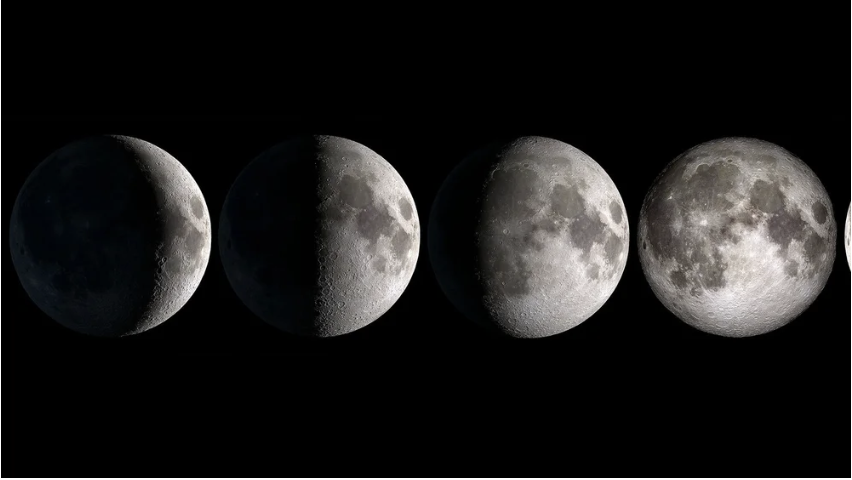
I was pondering a passage in the Qur’ān about the moon —“al-Qamar” in Arabic — and wondered if the word had any other meanings or metaphorical usage. When I checked the Quranic Arabic Corpus page, I saw that it lists a total of 27 occurrencesof al-Qamar in the Qur’an.
“Twenty-seven?” I thought to myself. “That’s only a few days shorter than the length of the lunar month.”
You see, this possible association — between 27 occurrences and the 29.5-days-long lunar month — popped up so naturally in my mind because when you read the Qur’an since your childhood, it is impossible not to become overpowered by its never-ending wonders and miracles that greet you seemingly every time you open its pages.
Yes, miracles… some of which are so profound and comprehensive that it would take volumes to show them in all their glory; others that are “bite-size,” so to speak — delightful wonders that can potentially be noticed by anyone who reads the Qur’an with an open mind and a sincere heart, and it increases their faith and warms their heart.
So, I had this nagging feeling — because the Qur’an never has a near-miss. Anytime it dangles a “marvel” or a “sign” in front of us that looks close-but-not-exact, you can be sure that there is a twist that we missed. And when we finally figure it out, we realize that the connection is even more perfect and beautiful than we had initially suspected.
As I was pondering these, I remembered a verse that mentions the “new moon.” Because there is a separate word for “crescent” in Arabic — al-Hilāl (الهلال) — this verse was not in the list for al-Qamar I had just looked up.
It turns out, the verse I had in mind was the singular appearance of al-Hilāl in the Qur’an (Q2:189):

Wisdom Lessons from Air and Wind
During an intellectual meditative journey into the word “Hû” — هُوَ in لَا إِلٰهَ إِلَّا هُوَ (There is no god by He) and قُلْ هُوَ اللّٰهُ (Say: He is Allah) and its meanings for the physical aspects of creation, I was contemplating the page of “air” when an exquisitely subtle point of tawḥīd (Divine Oneness) instantly manifested itself:
Indeed, just as a handful of soil that serves as a pot for a hundred flowers in succession, if attributed to nature and causes, would necessitate either that this small pot contains, on a miniature scale, a hundred — or perhaps as many as the flowers — invisible machines and factories; or that each particle of that tiny piece of soil possesses the knowledge to form all those different flowers, with their distinct properties and life-sustaining mechanisms, possessing endless knowledge and infinite power like a deity.
Likewise, each piece of air and wind, which serves as a throne for divine command and will, would require, within each fragment of wind, within each breath, within the tiny amount of air that forms the word “Hû” (هُوَ), the presence of miniature switchboards, receivers, and transmitters of all the telephones, telegraphs, radios, televisions, and all other types of communications that take place across the world, and be able to perform these endless tasks simultaneously and instantaneously.