Post 2: Gratitude — The Essence of Islam
In the previous post, we talked about the first sentence of the Quran (Chapter 1, Verse 1):

“In the Name of Allah, the Most Compassionate, the Most Merciful”
This declaration is not only the first verse of the first Chapter but is also found at the beginning of every chapter in the Quran, and Muslims are instructed to begin every good action in life by reciting these words. This is to remind us that as humans we are on this Earth by His Grace, and therefore we must be mindful that every one of our actions reflects the Compassion and Mercy with which God introduces Himself to us.
The First Page of the Qur’an
The first chapter of the Qur’an is named “Al-Fātiha”, which means “The Opener,” a fitting name for its role as the one that opens the doors to the 600-page Holy Book. A most profound feature of the Qur’an is that the entire Book is said to be contained (in summary form) in this first chapter — which is only 7 short sentences! (In fact, the first chapter itself is said to be contained in the first sentence, which is the one given above, but we will not delve into that right now. We will study these obviously bold claims in future articles.)
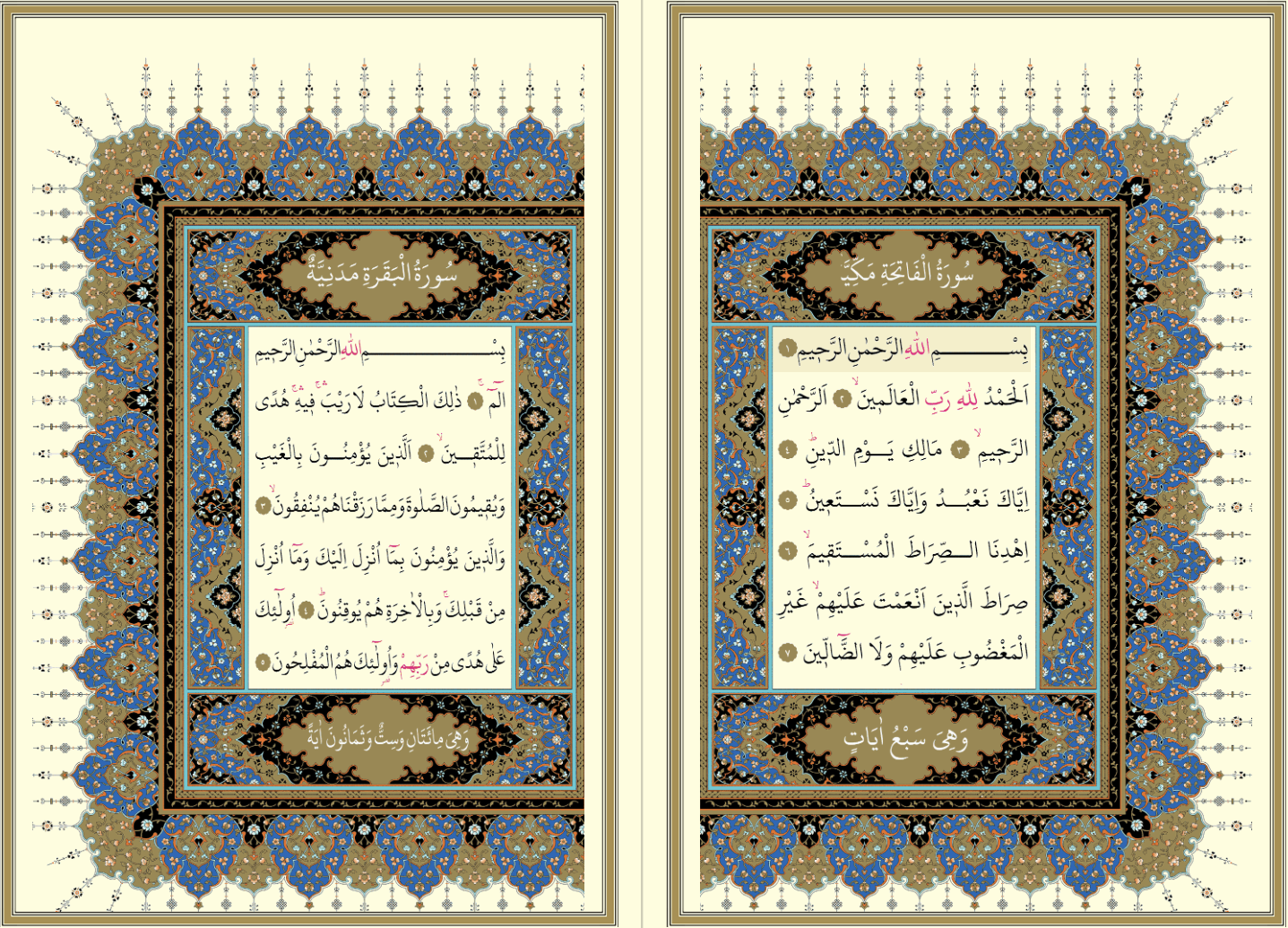
The first page of the Holy Qur’an: “Al-Fatiha” on the right page.
The first page — seen above — looks different from every other page in the Qur’an, which each has 15 lines of verses. In contrast, this first page has Al-Fātiha, on the right, and the first 5 sentences (also called “verses”) of the second chapter on the left. Both are placed in the middle of the page, with beautiful decorative art surrounding them, to draw attention to the extra importance of the words on this opening page.
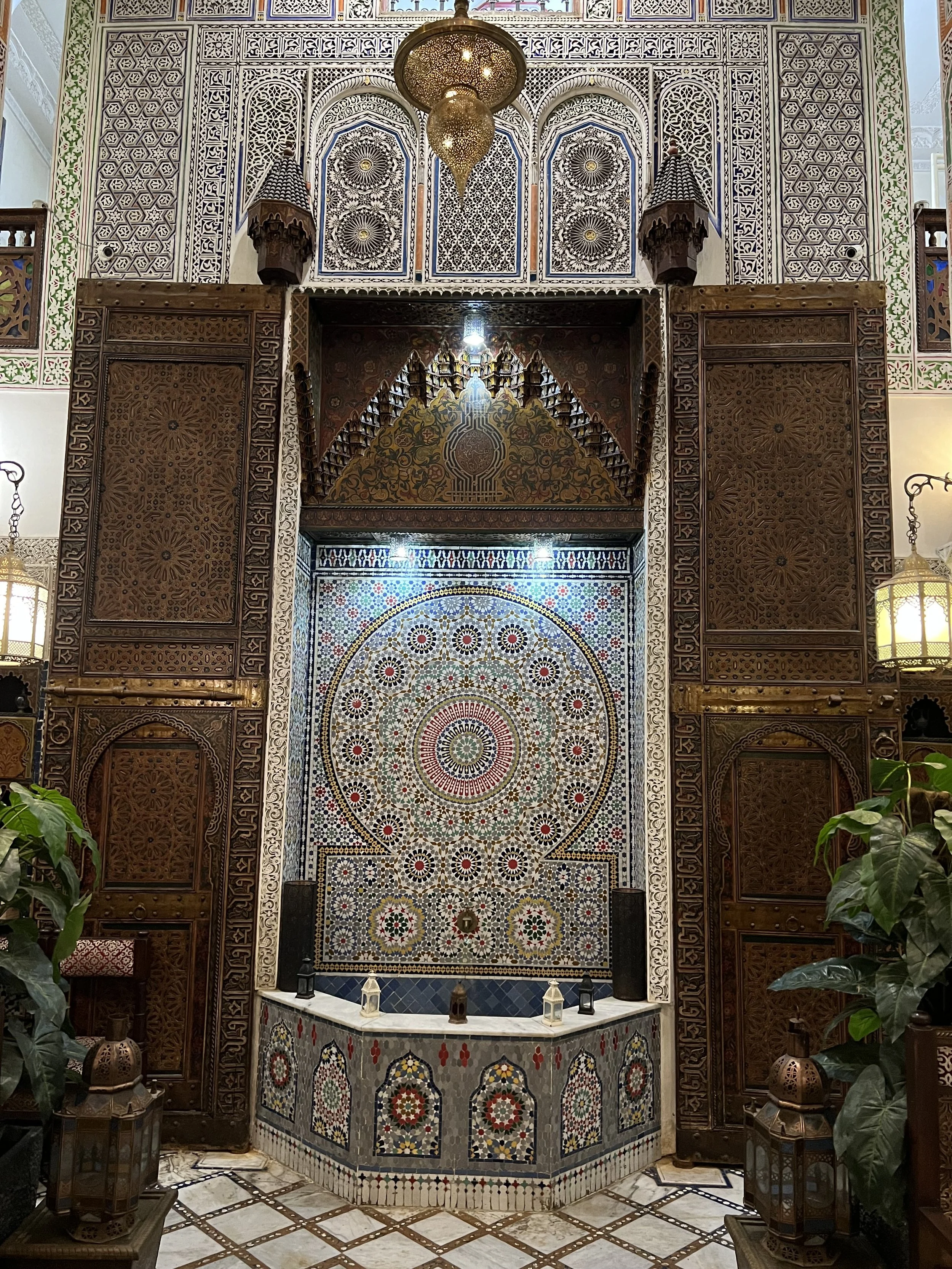
The way this opening page is arranged makes us feel like we are looking at the two leaves of a Grand Door that is about to open to reveal the treasures behind. A bit like this beautiful door below that opens to reveal a glittering fountain (at a restaurant I once visited in Morocco).
All this Introduction was meant to impress upon you the crucial importance of the first Chapter within the context of the Qur’an. I have not even mentioned that Prophet Muhammad (peace be upon him), called Al-Fatiha, “the Greatest Chapter of the Quran”.
Albert Einstein famously said that his greatest wish was to know “what God thinks.” So, if we were to wonder like that great genius for a moment and wonder:
If a Most Merciful God sends a 600-page book of guidance… to all humanity… that He intends to last for eternity… what would be the very first words of that book?
Here it is:
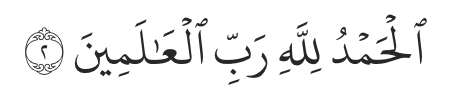
“All Gratitude and Praise be to Allah, the Lord (Cherisher and Sustainer) of the entire Universe.”
Such is the importance of these words that Muslims are instructed to recite this sentence (in fact this whole short chapter) at least 17 times a day!
The very first word God “speaks”, and by extension, the most important lesson He wants humans to understand — in this mind-boggling mystery in which we all found ourselves that we call life — is to be grateful.
That’s it. That’s all!
It is simply the realization of the immensity and beauty and perfection of all the gifts that God blessed us with by bringing us to life. In this wonderland, we call the Earth. In a much grander wonderland, called the Universe. And He does remind us that “He is the Cherisher and Sustainer of the Universe.”
How about “Praise” — also mentioned here?
Praise springs naturally from that realization. The hard part is the full realization, which is why it is the essence of gratitude.
When one of the greatest Muslim mystics said, “The truth was only a ‘dot,’ but the ignorant multiplied it,” he was referring to this simplicity of the truth:
You see, if one believes in God, one must also believe that He created and therefore owns the entire Universe. But then, do you really think that the One — who can create the Earth and the Heavens with all its hundred of billions of Galaxies and everything in them — is in need of our prayers? Or needs our money to give to charity? Or us fighting wars for him? Or us trying to convert people to his religion?
Of course, not.
If he can create every single atom in every single cell of every single human, believe me, he can make all of us believe in Him too — if that were what He’d wished. But that is not what He wishes, a fact stated repeatedly in the Qur’an.
Why not? Because He already has angels for that. Humans were created differently — endowed with the freedom to choose — and those who choose to believe in Him and love Him makes them precious to the Divine.
(This last point — about why were humans created in the first place — requires some more elaboration, and I cannot do justice to it here. I leave that to the another post.)
So, No. He does not need anything. There is nothing we can give him that He doesn’t already have… perhaps, save one: the Realization of His blessings to us. Which leads to Gratitude. Which leads to His Praise. Which leads to our loving Him with our free will.
Now you have the answer to the question that started this post:
The first lesson of the Quran, which is also the most fundamental expectation of God from humans in Islam is one word: Gratitude. In Arabic, the word is Hamd.
To understand how much Allah loves this word, it is sufficient to note that He named His last and most beloved Messenger with it not once or twice, but three times. Yes, Muhammad is from the same three-letter root as Ha-m-d.
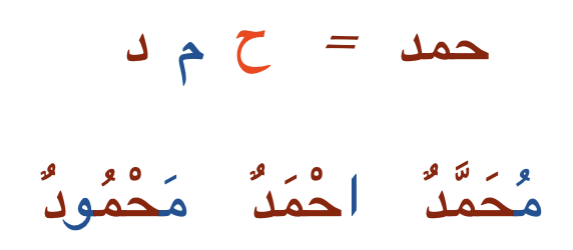
Bottom, right to left: Muhammad, Ahmad, Mahmud. All three names are derived from the trilateral Arabic root Ha-Mim-Dal for Hamd.
While Muhammad (pbuh) is his most well-known name — which means “He who possesses qualities deserving of overwhelming praise” — the Prophet of Islam has two other names that you may not have heard of (although they are well-known to Muslims):
Ahmad is his name in the Heavens and the angelic realms, which means “The best praiser (of His Lord).”
Mahmud is the unique title God promises him in the afterlife, and means “The Praised One”.
Just like Muhammad (pbuh), both of these names are also derived from the root Ha-m-d. And they all emphasize the immensity of his gratitude, as well as the fact that he himself is worthy of much praise.
To conclude:
If you are a Muslim reading this — emulate your Prophet, by focusing on gratitude, which is the source of all good in this world, and is the source of kindness, compassion, and mercy in our attitudes toward others.
If you are not a Muslim, now you know that the essence of Islam is very simple: Gratitude.
As any decent guest who is provided with an infinitude of gifts from a gracious host would acknowledge them with heartfelt thanks… that is all we are expected to do. To acknowledge. Like a decent guest.
That is the essence of my religion. It could be yours too.