ABCs of ISLAM
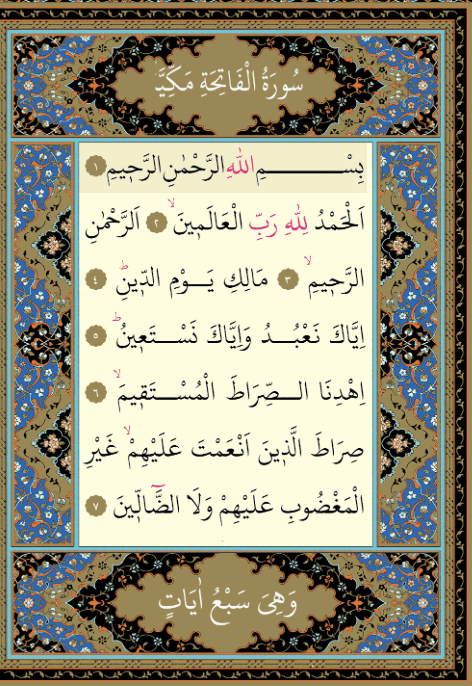
In the previous post (“What is the First Sentence of the Quran”), we mentioned that the the first sentence of the Quran was:
In the Name of Allah, the Most Compassionate, the Most Merciful
This declaration is not only the first sentence of the first Chapter but is also the first sentence of every chapter in the Quran, and Muslims are instructed to begin every good action in life by reciting these words. This is to remind us that as humans we are on this Earth by His Grace and His Love, and therefore we must be mindful that every one of our actions reflects the Compassion and Mercy with which God introduces Himself to us.
The First Page of the Quran
The first chapter of the Qur’an is named “Al-Fātiha”, which means “The Opener,” because it is meant to open the doors to the entire 600-page Holy Book. As mentioned in the previous post, the entire Qur’an is said to be summarized in this first chapter — which contains only 7 short sentences!
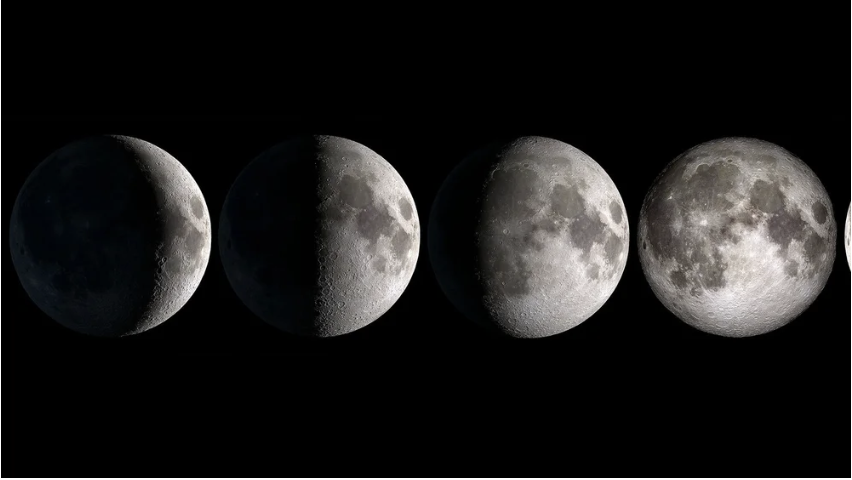
I was pondering a passage in the Qur’ān about the moon —“al-Qamar” in Arabic — and wondered if the word had any other meanings or metaphorical usage. When I checked the Quranic Arabic Corpus page, I saw that it lists a total of 27 occurrencesof al-Qamar in the Qur’an.
“Twenty-seven?” I thought to myself. “That’s only a few days shorter than the length of the lunar month.”
You see, this possible association — between 27 occurrences and the 29.5-days-long lunar month — popped up so naturally in my mind because when you read the Qur’an since your childhood, it is impossible not to become overpowered by its never-ending wonders and miracles that greet you seemingly every time you open its pages.
Yes, miracles… some of which are so profound and comprehensive that it would take volumes to show them in all their glory; others that are “bite-size,” so to speak — delightful wonders that can potentially be noticed by anyone who reads the Qur’an with an open mind and a sincere heart, and it increases their faith and warms their heart.
So, I had this nagging feeling — because the Qur’an never has a near-miss. Anytime it dangles a “marvel” or a “sign” in front of us that looks close-but-not-exact, you can be sure that there is a twist that we missed. And when we finally figure it out, we realize that the connection is even more perfect and beautiful than we had initially suspected.
As I was pondering these, I remembered a verse that mentions the “new moon.” Because there is a separate word for “crescent” in Arabic — al-Hilāl (الهلال) — this verse was not in the list for al-Qamar I had just looked up.
It turns out, the verse I had in mind was the singular appearance of al-Hilāl in the Qur’an (Q2:189):

The ABCs of Islam is a series of short, accessible articles introducing the basic tenets of Islam — written for the educated and curious reader who is looking for reliable, honest, and human answers.
As you can imagine, writing these articles takes considerable time. So why am I doing it?
The honest answer is: my friends made me.
Over three decades ago I left my native Turkey to do a PhD in Economics in the United States. The friends I made there knew little about Turkey or Islam — just as I knew little about Thailand or Argentina, or about Buddhism or Catholicism. We were curious about each other in the way that people who genuinely like each other tend to be.
But they were also hearing about Islam in passing — usually in the context of a war, an immigration crisis, or a terror attack by people who claimed to speak for Muslims. The picture was rarely flattering, and rarely complete.
Sometimes, thankfully, their curiosity came from warmer places:
Why was I not eating — or drinking — anything during the day in Ramadan?Why was that new student in class covering her hair?Why did I believe in God at all?
These are not easy questions to ask someone. But I never felt awkward or defensive about them — perhaps because I grew up in a home where no question was too uncomfortable. My father, a scholar of Islam and a devout Muslim, always responded to my questions with patience and thought. I tried to do the same.
On the contrary, I felt I had found kindred spirits. My friends felt comfortable asking me things they were afraid to ask others — for fear of giving offence, or of seeming ignorant. And I genuinely loved thinking through the answers with them.
Over the following decades I heard the same questions asked again and again — by different friends, in different cities, at different stages of life. It became clear that there must be many others out there wondering the same things.
Which is how this series began.
Here is a selection of the topics this series plans to cover:
On God: Who is God according to Islam? What does He want from us — and what does He promise in return?
On the Quran: What is the Quran? Why do some call it a miraculous book — and why do others find it hard to understand? Who wrote it, what does it contain, and how does it differ from the Bible?
On Muhammad: Who was Muhammad (pbuh)? Where and when did he live? What were his main teachings and what legacy did he leave? Was he a warlord? Who did he marry, and why?
On Jesus Christ: What does Islam teach about Jesus? Is he the Messiah? What about the virgin birth?
On women: What is Islam's view of women, and how do women's rights in Islam compare to other traditions?
On Islam and the modern world: Is Islam compatible with modern science? With democracy? With freedom of conscience?
On other faiths: What do Muslims believe about Christians, Jews, Buddhists, Hindus, agnostics, and atheists?
On violence and extremism: What is Jihad — really? Why does Islam so often appear in the context of war and terrorism, and what does that context leave out?
Obviously, this is a short list, and there are many other pressing questions that other readers might want to know about.
So, feel free to submit your questions for future articles using the message form below.

The Quran is the Divine Book of Islam, and Muslims believe that it is the Word of God, unaltered. And Prophet Muhammad (peace be upon him) said it will remain “his greatest miracle until the end of time.”
Clearly, these are bold claims, and a non-Muslim has every right to be skeptical about their truth. I will discuss these claims and the evidence put forward in detail in future posts.
For now though, what matters is that regardless of whether you believe this or not, these statements reflect how Muslims view the Quran.So, if you want to know what Islam is — as understood by Muslims — you start with the Quran.
First: A unique feature of the Quran is its hierarchical structure: that all the (600-page!) Quran is summarized in its first Chapter (1/3-page long!), and that the first chapter is summarized in the first Sentence.
(You may notice that this is precisely the format of modern scientific articles: “Article summarized in Introduction summarized in Abstract”, which I find pretty remarkable for a book that goes back 1500 years.)
So, what does that first sentence say? Here it is:
A Story for young adults, those young at heart, and all Harry Potter fans.
A gaggle of Hogwarts students, their robes askew and faces alight with curiosity, once gathered around me in the shadowy depths of the library. “Professor”, they whispered, their voices hushed with reverence:
“Tell us of ‘the Secret One’. Our teachers speak only of potions, spells, and charms, but not of the Secret One who first conjured real magic into being.”
I smiled, a twinkle in my eye. “Ah, but my dear students,” I replied, “each subject you study, every potion you brew, and every charm you cast, whispers of the Secret One in its own mystical tongue… Listen closely, and you shall hear the echoes of His divine hand in every incantation.”
“Imagine, if you will,” I began, “a most extraordinary apothecary, its shelves brimming with shimmering glass bottles and bubbling cauldrons. Within each jar, a wondrous elixir, brewed with ingredients gathered from the farthest reaches of the enchanted world, each measure precise and potent…
Surely, such a wondrous place would speak of a master alchemist, a potioneer of unparalleled skill. So much so that, even our legendary Headmaster Albus Dumbledore wishes he could be an apprentice at the feet of such a Lord of Magical Medicine.”
“And so it is with our Earth,” I continued, “a living apothecary, teeming with millions of species of magical creatures and fantastical plants, each a vessel brimming with life-giving remedies. This Earthly apothecary, far grander than a thousand Diagon Alleys, whispers of a Divine Healer, a Genius Scientist who breathed life into every beast and bloom.”